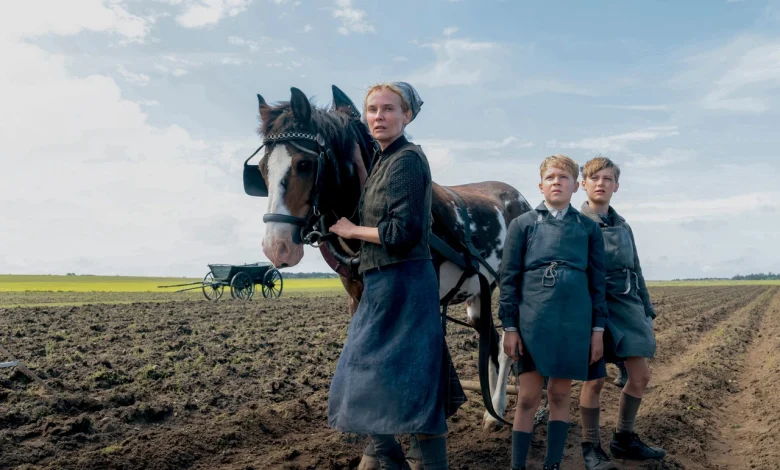
Amrum (2026): A Poignant Exploration of Innocence Amidst the Ruins of War
- Category: Drama / Historical
- Release Date: April 17, 2026 (Limited)
- Cast: Jasper Billerbeck, Laura Tonke, Diane Kruger, Lisa Hagmeister, Kian Köppke, Detlev Buck
- Language: English (Original Language: German)
- Film Runtime: Approx. 112 Minutes (TBA)
- Director: Fatih Akin
The Winds of Change: An Introduction to Amrum (2026)
Coming to select theaters on April 17, 2026, Amrum is the latest cinematic offering from the world-renowned director Fatih Akin. Known for his raw, emotionally charged storytelling in films like In the Fade and The Golden Glove, Akin shifts his focus to the final days of World War II. Set on the isolated, windswept German island of Amrum in the North Sea, the film provides a unique perspective on the collapse of the Third Reich through the eyes of a child.
Distributed by Kino Lorber, Amrum is already generating buzz as a top contender for international film awards. It captures a specific, frozen moment in history where the grand ideologies of war clash with the simple, desperate needs of a starving family. At fmovies.tr, we explore why this historical drama is an essential watch for those who appreciate cinema that balances breathtaking landscapes with heartbreaking human truths.
The Plot: A Child’s Quest in a Dying World
Spring 1945: The Island Outpost
The story unfolds in the Spring of 1945. While the rest of Germany is being torn apart by Allied advances, the island of Amrum remains a quiet, almost surreal sanctuary. Life for 12-year-old Nanning (portrayed by newcomer Jasper Billerbeck) is defined by labor rather than bullets. He spends his days working the family farm and his nights fishing in the cold North Sea to help his mother, Hille, keep the family alive. To Nanning, the war is a distant abstraction—a background noise that hasn’t yet shattered his idyllic island life.
The Clash of Ideologies
The tension of the film lies in the internal world of Nanning’s home. His mother, Hille (Laura Tonke), is a “true believer”—a staunch supporter of the Nazi regime whose identity is tied to the survival of the Reich. As news of Germany’s imminent defeat trickles onto the island, Hille falls into a physical and mental decline. Conversely, their neighbor Tessa (Diane Kruger), an anti-fascist, quietly celebrates the end of the conflict. Nanning, caught in the middle, innocently hopes for peace simply because it means his father, a Nazi officer, might finally return home.
The Quest for White Bread
From her sickbed, Hille makes a simple request: she wants white bread, butter, and honey. In the scarcity of 1945, these are impossible luxuries. Nanning, driven by a pure, unpolitical love for his mother, sets off across the island to find these items. However, his journey reveals a terrifying reality: the “enemy” and the violence of the war are much closer than he ever realized. The island’s beauty begins to peel away, revealing the rot of a losing war and the desperation of those left behind.
The Cast: Fresh Talent and Seasoned Stars
Fatih Akin has assembled a cast that perfectly captures the isolation and intensity of the setting.
Jasper Billerbeck: A Breakthrough Performance
The success of Amrum hinges on the character of Nanning, and newcomer Jasper Billerbeck delivers a powerhouse performance. He brings a sense of wide-eyed innocence that slowly hardens as the film progresses. His ability to convey complex emotions—confusion, hope, and eventually, a harsh awakening—makes him the true anchor of the film.
Laura Tonke and Diane Kruger
Laura Tonke is haunting as Hille. She portrays a woman whose entire world-view is crumbling, using her physical decline as a metaphor for the falling regime. Diane Kruger, reuniting with Akin after their success in In the Fade, plays Tessa with a quiet, dangerous strength. Her presence serves as the voice of reason and the herald of a new, post-war world.
Supporting Excellence
The film also features Lisa Hagmeister and Detlev Buck, who flesh out the island’s community. These characters represent the “silent majority” of the time—people trying to survive the transition of power while grappling with their own complicity in the horrors of the era.
Directorial Style: Fatih Akin’s Visual Poetry
The Beauty of the North Sea
Fatih Akin utilizes the island of Amrum as a character in its own right. The cinematography captures the “windswept isle” with a mixture of awe and melancholy. The vast horizons of the sea emphasize Nanning’s isolation and the feeling that the island is a bubble about to burst. Akin’s direction is patient, allowing the environment to build a sense of dread that is palpable even in the film’s most beautiful moments.
A Departure from Urban Grime
While much of Akin’s previous work is set in the gritty urban centers of Hamburg or Istanbul, Amrum proves he is just as capable of handling historical epics. His focus remains on the “outsider,” but here, the outsider is a child who doesn’t yet know he is on the wrong side of history. It is a masterful subversion of the traditional war movie.
Critical Analysis: The End of Innocence
The Politics of Hunger
Amrum is a film about the stomach as much as it is about the heart. The quest for bread and honey is a brilliant narrative device that strips away the high-minded rhetoric of the Nazi party and reduces life to its most basic elements. By focusing on a child’s innocent attempts to please his mother, the film highlights the tragedy of a generation raised under a poisonous ideology.
A Different Kind of War Movie
There are no massive tank battles in Amrum. The conflict is found in whispered conversations, suspicious glances between neighbors, and the slow realization that the world is changing forever. It is a “suspenseful” drama in the truest sense, as the audience knows what is coming, but Nanning does not. This dramatic irony creates a sense of tension that carries the film through its more meditative passages.
Why Amrum is a Must-Watch
Amrum (2026) is a profound, beautifully shot, and emotionally devastating film. It manages to tell a “small” story that reflects the “large” tragedy of the 20th century. Fatih Akin continues to prove why he is one of the most important directors working today, offering a story that is both specific to German history and universal in its depiction of childhood and family loyalty.
On fmovies.tr, we rate this film as one of the standout dramas of the year. Whether you are a fan of historical cinema or simply looking for a story with deep emotional resonance, Amrum is a cinematic journey worth taking. It reminds us that even on the most remote islands, the consequences of history are inescapable.